What is the Meaning of 太极拳 Taiji Quan (AKA Tai Chi Chuan)?

One of the great misunderstandings brought to the west with the popularization of “Tai Chi Chuan” is the meaning of its name.  This practice is constantly referred to as ‘Grand Ultimate Fist” among more bizarre translations.  It is also fairly (and painfully) common for people without an understanding of Chinese language to try to understand and translate the name as if it was “Tai QI”, believing that the second character relates to QI meaning omnipresent essential universal energy.

Some of the confusion relating to the commonly used Tai Chi Chuan relates to the fact that this particular spelling in English comes from an antiquated system of converting Mandarin Chinese sounds into romanised English spelling.  This spelling originates from the Wade-Giles romanization method which is no longer used in Mainland China.  This system uses a specific arrangement of punctuation to denote tones and certain sounds which English does not have.  While an honest effort, as a conversion to English it is neither particularly user friendly nor clear in portraying these sounds.  The spelling, Tai Chi Chuan, phonetically in English would more accurately be written as, Tie Jee tchwanne, the last part ending like the Female name, Anne. So as we can see there is not even a phonetic similarity to the word, QI, meaning energy, which phonetically could be accurately spelled as Tchee.

Some other errors in understanding originate from the efforts of Chinese immigrants to the west possessing little or no knowledge of English, or Westerners with the same lack of Chinese language, attempting to explain the term, Taiji (太极) to westerners by using common dictionary definitions.  One of those definitions can be found as, “grand ultimate fist, another grand terminus fist.  Neither are particularly useful.

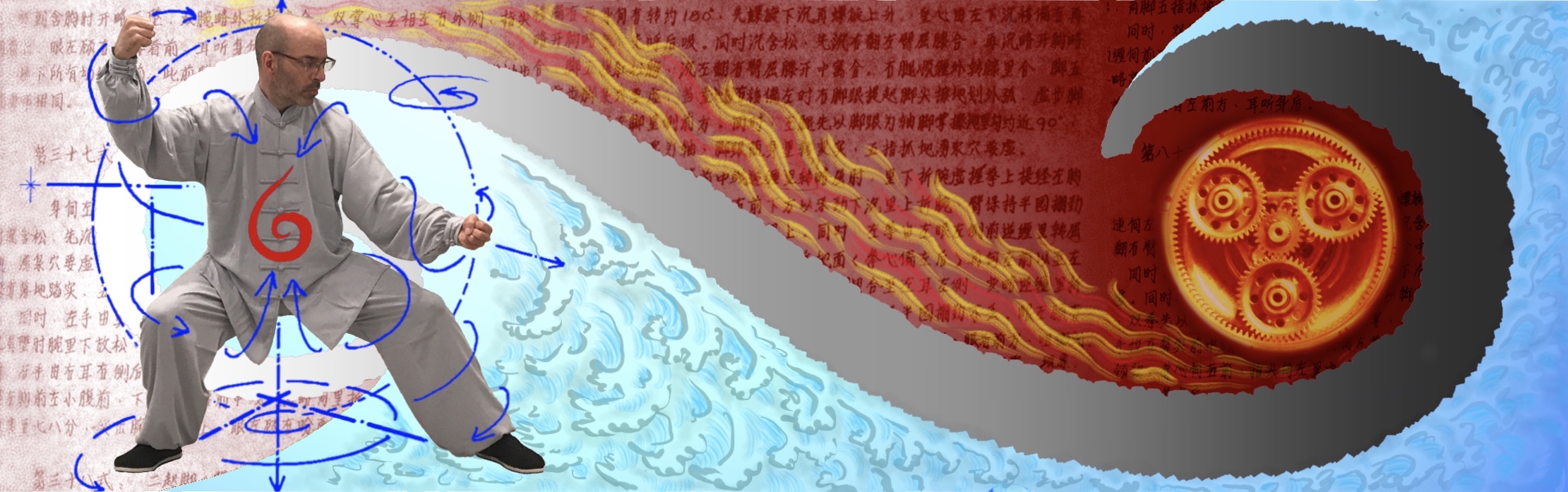
The accurate truth is that “Taiji” 太极 is a Chinese cosmological concept that well predates Taijiquan.  The fist (martial art & health system) was took the name of an existing philosophical concept as it was both designed in its image, as well as illustrates it.  The term, Taiji 太极 represents the flux, the change, and relationship between and within the opposing and complimentary forces of Yin (negative, feminine, dark, formless, attracting) and Yang (positive, masculine, bright, substantial, repulsing).  The Taiji concept refers to the constantly changing and dynamic interplay between these energies that is the foundational action that hold the universe together.

This concept, Taiji is one way to express the workings within Dao, which refers to, essentially universal existence, and the ‘way’ it operates.  The word itself can simply translate to ‘way’ which is similar to ‘path’ or ‘road’ in Chinese.  Dao, not only refers to the way things are, but also to being on the ‘path’ of practicing a method of bringing one’s self to harmony with the way things are.  Dao is a very big topic, but the common diagram that most would be familiar with seeing that represents Dao, is called the Taijitu, which is the diagrams with what is known as two fishes, one black with a white eye, one white with a black eye, chasing eachother in a circle.  Each extreme contains a kernel of it’s opposing energy. This is again, Taiji.

One interesting interpretation was given to me years ago by my first Taijiquan teacher, Chen Jinhong, as, “from the most extremely large to the uncountably small (few)”.  Essentially, the meaning here is the movement, or relationship between the greatest unfathomable extreme, to the smallest unfathomable kernel.  This again, is the relationship between Yin and Yang.  Interestingly, it also sounds very much like western science’s theories of the workings of the ‘big bang’.

Understanding the above points, the actual meaning of Taijiquan, or Tai Chi Chuan or 太极拳 is, the Taiji concept fist system, or to be very lengthy, the fist system based on the dynamic relationship between Yin and Yang.  The possibilities for obtuseness or verbosity both may be reasons why anyone would want to avoid getting into the subject altogether and look for a simple dictionary definition, which of course is likely to be totally inaccurate.

Rule Vs. Compromise in ‘Advanced’ Chen Taijiquan Practice; Leaning in Form Practice Part 1

Taijiquan has become a sort of spectator sport, which is to say that people have grown very accustomed to understanding Taijiquan visually. people who watch and critique often, and often as a primary way of learning about it, are generally accustomed to watching Chinese people in long silk (satin) outfits performing it. Besides the traditional cultural significance of such outfits, they have two distinct purposes in martial arts performances: a) they hide the visible structure and/or method of the body, including legs, torso and pelvic areas specifically, and b) they make the body movements appear softer and more flowing than they actually are, which is desirable for Taijiquan. One of the effects of this habit of viewing is that when the silk veil is removed some people get confused, a they are not used to seeing the movement in broad daylight.

Being a western practitioner in a well known line is also a complicated situation. It is an unpopular subject to discuss, especially in places like this, but perhaps people have heard to southern saying about “crabs in a bucket” specifically relating to people living in the ghetto being the most aggressive to attack their peers who attempt to raise themselves out of poverty?
Generally, Chinese people either don’t care about someone like me, or they want to prove that they can beat a westerner, or they simply think it is worthy of respect that a westerner worked at learning Chinese gongfu. However, westerners if they practice gongfu, will try to attack what they see much more aggressively especially if they are not very accomplished, perhaps out of some feeling of jealousy. I have seen this time and time again, just like crabs in a barrel; any time one gets a claw on the rim to climb out the others trying to climb out will pull it down.

I have come to understand this after years of teaching and publicizing the real practice with a very non-commercial outlook; If you pay your dues and do the hard work many western enthusiasts will be uncomfortable with that, and vocalizing it is much easier than paying dues and doing hard work yourself. A very large percentage of Chinese martial arts ‘aficionados’ are much more interested in the realm of fantasy (worship of and romance with the exotic Chinese father figure) than they are in the realities of personal practice and development. If a westerner were to actually develop authentic traditional gongfu skill and make it their own, and even possible further it in the traditional way, they in fact threaten this fantasy that so many western students prefer to live within.
The fantasy (and there are myriad within this complex) has to do with the exotic possessing an unreachable impossible skill and one’s self being genetically, or culturally inferior. In the end this fantasy supports the notion that there IS a strong protective and magical daddy out there for you, and that is what a lot of people simply need and their reason for getting involved in martial arts. If I tell you that your daddy is a myth and show you that Taijiquan skill has no relationship to that myth, that can be very unpleasant, regardless of its accuracy.

Rule Vs. Compromise in ‘Advanced’ Chen Taijiquan Practice; Leaning in Form Practice Part 2

Taijiquan has a set of physical rules one is supposed to abide by, once they learn to even implement them properly, or they could be said to be practicing incorrectly or not even practicing Taijiquan by some folks. I’ll address just a few of these that relate to this issue specifically. It is said that the back must be straight and upright, the knees must not extend past the toes, the bum must not stick out, the head must be upright, the chest sunk, the upper back convex, and the list goes on and on. These are all good rules, but like all rules… well, the most ardent advocates of rules are always novices, because without embodiment of gongfu, adhering to rules is firstly the closest you will get, and secondly alleged to be the path to gongfu, “allegedly”.

I am not saying that these rules are bad, they are fine and useful, but without teaching, and without understanding they are quite useless. So, I want to put in perspective a bit some of these rules and how they really work in a dynamic environment. Firstly, the back straight and upright, everyone wants to achieve this because it allows the rotation of the central axis between tail and crown to be loose and neutral, as well as makes one feel much better (relating to qi) during practice.

Secondly, the bum not protruding; again everyone would want this ability because it refers to a few specific mechanisms; the ability to engage the bum to foot musculature, the lower back structure and the opening of dantian for both breath (qi cultivation) and Chansijin action, and again it also just feels better during practice.

Thirdly, the knees not passing the toes, you’d think everyone would want this because of multiple benefits; joint health because knees are not well constructed to withstand kinetic weight bearing stresses past the angles reached when at the toe line. Additionally, particular natural physiological root and arch (dang) structures reduces the more the knees pass the toe line.

If we take these three rules, each one is fairly straightforward on its own, but combining them is already very very complicated and in my view and experience that is my job as a teacher to convey. It is very challenging to teach and it is specifically what a great majority of Chen Taijiquan teachers do NOT teach. It is also what a great majority of Taijiquan students do not understand. It is also additionally what many of the normal critics do not understand because they have not made it far enough down the path to experience the difficulty or possibly even unwittingly chose or were taught a specific compromise that escaped the paradoxes of these compounded rules. This deeper teaching is really very hard to resolve for one’s self even as an advanced practitioner, before we can think of them even trying to clarify it for students.

Rule Vs. Compromise in ‘Advanced’ Chen Taijiquan Practice; Leaning in Form Practice Part 3

The great majority of well known ‘high level’ Chen Taijiquan representatives ALL either lean, pass their toes with their knees, or stick out their bum, at one time or another during form practice. It is not because they do not have gongfu, or don’t understand the rules. It is precisely because they do understand the rules and are beyond the trap of rule adherence and simply practice gongfu compromising their chosen rules when it suits them in the interest of specific goals such as a low horse for example.
If one looks objectively at performances of well known representatives of the fist one can clearly see that this is how it works:
If the horse is very low, the practitioner will either:
1) Lean forward to move hips to the rear to accommodate stepping or stance with knees within toe line,
2) Make the stance extremely wide to allow the knees to extend more without passing toe line, thereby reducing mobility greatly,
3) Allow the knees to pass the toes moving the center of gravity forward making it easy sit up straight,
4) Allow the bum to protrude to move the hips to the rear, allowing the knees to stay within the toe line.

These are factual physiological realities that everyone has to contend with. It is not something anyone can hide from the experienced. Only novices and those who have not gone far enough will think this is hidden in plain site, because they are simply have not yet acknowledged their own or their teacher’s chosen compromise.

There are also distinct differences in the goals and methods of various lines within Chen fist, specifically in the areas the legs. This is also clearly visible these days. The way I was taught, Chenyu’s received methods from his father has a moderate length horse; it should be only two shoulder widths for gongfu practice (not performance). this moderate length horse is for martial arts, it can be heavy but it is mobile. If the horse is too wide the body weight is dispersed too far and it is too difficult to consolidate the body weight and essentially, root. For those who know about Chen Zhaokui, his stance was also known to be very low and there are many photos available. Truly this very low and narrow horse is the hardest to achieve and the great majority of ‘students’ and certainly western students have not even had a seconds experience IN that horse as they cannot even get close to sitting into it successfully and properly. Besides the simple pain of it, this close conflict of rules that makes it so challenging. This simply cannot be ‘understood’ within being IN that horse enough to discuss it, online for example.

In my practice, occasionally I lean a bit, certainly no worse, and in some case not nearly as bad as many famous Chen family representatives who train a low horse. In my practice My knees are much more consistently behind the toe line than some of the Chen family reps. and my bum? I know it is HOT, I mean a hot topic, but here is the other issue: The majority of Chinese people have flat bums. One would have to be willfully blind not to notice this. My ancestry is middle eastern, I have a big butt and practice only made it bigger. When I straighten my tail bone, my gluteal muscles will still appear round, because they ARE round. They are not expressing the curve of my tailbone. Chinese people, most of them do not have bums shaped like this, and so the majority of those who gets their info from watching will be understandably confused because they are constantly watching Chinese people and they never see a round bum.

Additionally, Chen Zhaokui’s line specifically uses dantian movement and folding that others do not, so occasionally the flexing of the lower back will be visible. I can pretty much guarantee that those who advocate NEVER seeing the lower back flex and the butt appear to protrude at all, also do not practice a low narrow horse with the knees within the toe line. A reliable (meaning someone who could do that consistently, not a still photo) example would be very hard to produce.

Again, this goes back to the general discomfort with respecting a western gongfu practitioner simply because they do not represent the magical body type that some people think they will achieve if they practice. It is a pervasive mythology, that one’s body will change into the burly barrel chested Chinese martial artist they see in the video from practicing right, but I have news, again, that will NOT happen unless you are genetically set for it. You can change your body to a certain level, but it is not what people imagine or claim it will be. You can do the best with what you have, but you are not going to change a frog into a prince with gongfu practice. People who watch TOO MANY Chinese gongfu videos and have too little development of their own come to think that Chinese gongfu development looks like Chinese body. It does not. You will not become nearly hairless, nor single eyelid, nor gain a layer of fat under your skin, nor will the angle of your hip-pelvis joints change to something else, no matter how hard you practice. You can only improve what you have been given. If I were to try to make a video with my butt really becoming flat and invisible from the side you would see my back being totally and consistently rounded (convex) which is undesirable for Chen Taijiquan.

Rule Vs. Compromise in ‘Advanced’ Chen Taijiquan Practice; Leaning in Form Practice Part 4

I am going to share some photo stills from videos of well known “leaning towers of Chen,” Knee protrudes, and bum protrudes as well to illustrate the point. I have learned something over the years that is both humorous and disturbing, relating to my opening points. As a well known serious and public practitioner of any line, even if you have actual gongfu skill if you chose to or habitually sacrifice some rule to achieve a practice or demonstration goal you can only get away with it avoiding public criticism if you:
1) wear a silk suit with a long top to hide your bum as much as possible, preferably a baggy one to hide the angle of your possibly leaning back,
2) Have Chinese features or at least some sort of Asian genetic history to avoid being pulled down by novice crabs in a bucket who would praise the exact same methods in their fantasy exotic far-eastern daddy figures.

Leaning Towers of Chen:
From the top first row: Chen Xiaoxing (lot of leaning)
Second: Chen Xiao Wang (copious leaning)
Third: Chen Xiao Wang then Chen Xiaoxing (profuse leaning and shameless ‘Bum Protrusion’)
Fourth: Wang Xian (rinse and repeat)
Fifth: Wang Xian (rinse and repeat)
Image

Chenyu’s Glute development clear as day (his is not so flat):
Image

Chen Bing Low horse leaning and knee passes toe:
Image

Chen Bing high horse straightens up:
Image

Chen Bing visible buttock-lower back arch:
Image

Chen Bing back straight knees pass toes:
Image

Chen Fake low horse wide with back straight:
Image

That ought to be enough to clarify the point.
There would be no end to such examples I could find. I did not select nor omit any particular name for any reason. There are clear examples of them ALL looking like that, I am actually not particularly unique in that way, better in some areas worse in some areas than whomever you choose to compare to. In short, whether or not one appreciate my ‘style’ I am just like the big names; not perfect. That’s right, they are not perfect either, although for some they are much more pleasing to worship.

Generally, what we can see in the photos and the videos some of these stills were taken from is that those who appear to sit very straight, actually only sit very straight at the end of many moves when the photos will be taken, or when they stand up high. The transitions, the stepping, and the difficult low spots are often quite a different story.

Some of the practitioners in the photos leaned more when they were younger and now they are serious advocates of 100% straight and upright. Why and how did they make the change?
First of all sitting upright feels better, really, but when you are younger, practicing low also feels better if you like bitter gongfu, so that is a toss up. How did they do it? In most cases people straightened up their backs by discontinuing the low practice, or allowing their knees to pass the toes liberally, or BOTH. When I said the narrow low horse offered a very serious challenge to keeping a straight back I meant for everyone, not specifically for me. Hopefully this article helps people understand this.

M.S.

Traditional Taijiquan Gongfu Does Not Mix

Among the weekend warrior, or ‘enthusiast’ crowd, it has become popular over the years to think and then claim that one can or should practice ‘some’ Tai Chi for specific benefits while practicing other arts for other benefits that Tai Chi supposedly lacks.  This is a small piece I wrote on this some years ago.

Generally, if we eat, let’s say a massive plate of enchiladas and carne asada we may digest it just fine with the expected and desired effects of a bit of temporary full body paralysis, and a bout of severe farting.  However, if we then mix it with a Thai dish of say, pineapple coconut milk chicken curry, most likely we are going to run into some nasty digestion problem, an uncomfortable situation.  Not all foods mix, like they say, do not drink citrus after eating beans because it causes indigestion.

I think many so-called “external” arts can be mixed and matched if the methods are agreeable to each other, however some so-called “internal” arts are very selfish; they are designed (planned) to be one’s only and overriding method.

Unless one’s Taijiquan for example, is very superficually practiced, it is not meant to mix with some other method, and generally won’t mix with many others besides a few perhaps similar internal methods.  The goal with something like Taijiquan is to develop, over the long term, a body method that is all encompassing and becomes natural to one’s movement.  Equally important is the long term development of a specific (different) way of engaging force.  If this body method and engagement method are not natural/habitual, or at least heartily intended, then one cannot say they “understand” Taijiquan.  There is no “understanding” in a cerebral way, there is only physically achieving through practice, then “understanding” what was realized.

If one has achieved this body method and engagement method, they do not then have the “choice” to apply it or not.  If it has become natural at that point.  It just is, there is no-off switch, training is a one way path.

If we claim to know Taijiquan but we still hard rigidly punches like a Jackie Chan movie, its rather meaningless.  Really “digesting” Taijiquan means following through with the training to the point of naturalization of its methods.  At that point it may be interesting to know the practitioners view on the possibilities for “mix and match”.  Before that point it is useless speculation of a physically unrealized concept.

My first teacher, Chen JinHong, used to say, “Night-train or Cobra (two different kinds of very strong and very cheap hard liquor found in USA) will get you drunk fast, but Chen Taijiquan is like Napolean brandy”.  It is fine to mix and match Budweiser and Coors, (cheap beers) it’s all piss on the way out.  But if you want to mix Napolean brandy, or some expensive vintage wine into the mix, then you have really missed the whole point and wasted a huge bit of cash.